

Directional boring
Horizontal directional drilling for utility-scale conduit, duct, and pipe across five states, from fiber service laterals to long crossings under highways, rivers, and rail.
What directional boring is, and when it is the right method
Horizontal directional drilling installs conduit, duct, and pipe underground without trenching the surface above it. A steerable drill head is guided along a designed path from an entry pit to an exit pit, the bore is reamed to the diameter the product needs, and the product is pulled back through. Roads, driveways, rail beds, wetlands, and mature landscaping stay intact.
Boring is the right call when the surface above the path is expensive, protected, or impossible to close. A four-lane highway crossing, a river bank, a rail right of way, a city street a municipality cannot shut down for a week: all of these are bore shots rather than open cuts. It is also the right call at scale, because a bore crew can put in a long crossing in a day that a trenching crew would spend a week on and then still have to restore.
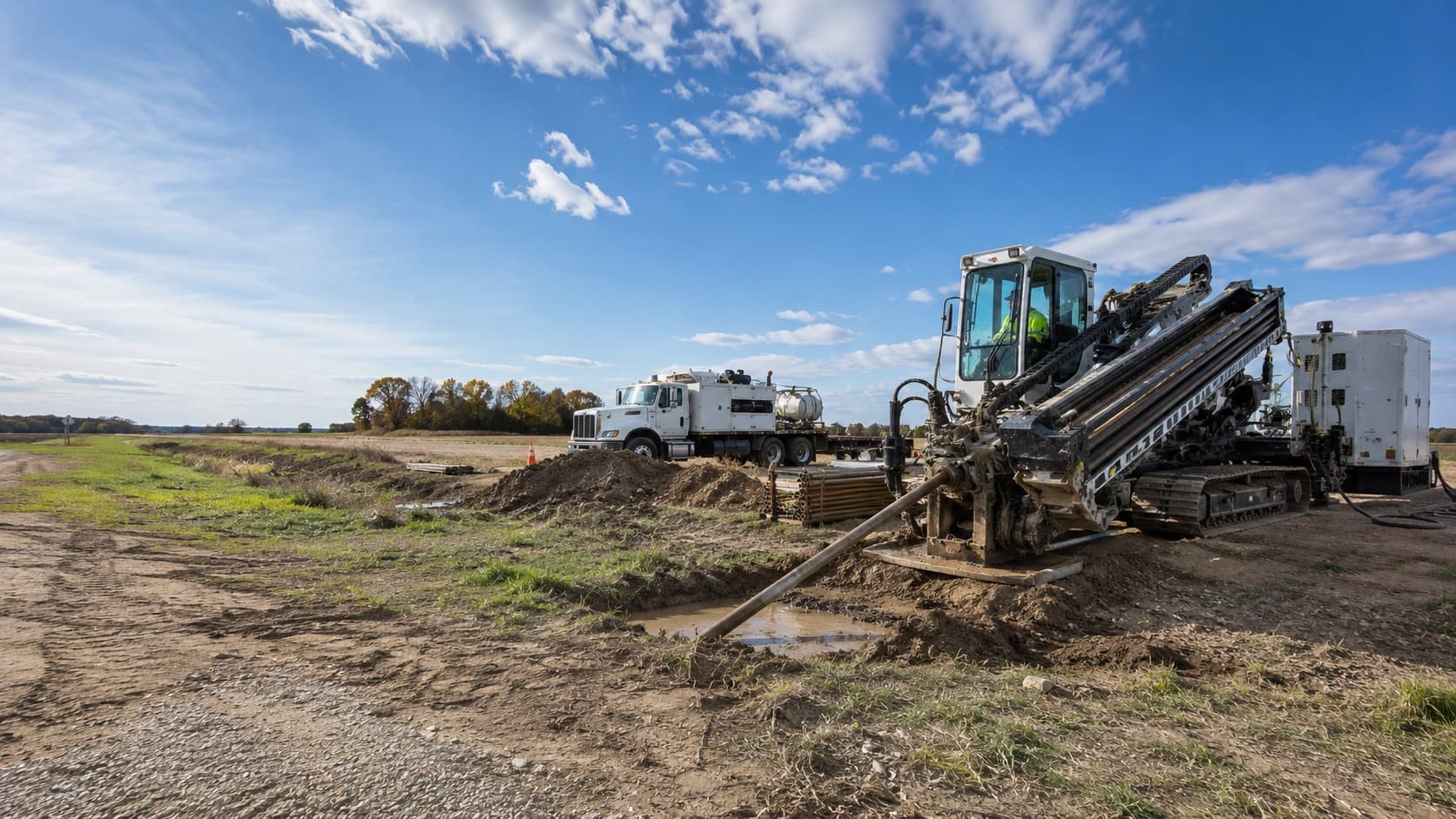
Miller Utilities runs its own drill rigs, locating equipment, and mud systems, and our crews bore for fiber, electric, gas, and water clients across the Upper Midwest. That matters on a bid because nothing on the critical path is rented or subcontracted.
Built for the crossings that decide a schedule
Most builds do not fall behind on the easy runs. They fall behind on the one crossing that needs a permit, a bore plan, a locate, and a crew that has done it before. That is the work we are usually brought in for, whether it is a single shot under a state highway or every crossing in a whole-city fiber build.
We work for municipalities, internet service providers, and developers, most often as the underground contractor on a build the owner is coordinating across several trades. Scope can be a single bore or a full package of boring, plowing, blowing, and restoration under one contract.
What our boring crews bring to a build
Rigs, locating, and the paperwork that keeps a bore legal and on schedule, run by crews that do this every week rather than occasionally.
Bore planning and design
Entry and exit points, depth, radius, and clearance from existing utilities worked out before mobilization, so the plan survives contact with the actual right of way.
Locating and potholing
Existing facilities located and physically verified by potholing where the design runs close. The cheapest way to avoid a strike is to look at the pipe before you bore past it.
Highway, rail, and river crossings
Long crossings under state and county highways, rail right of way, wetlands, and waterways, drilled at the depth and cover the owning agency requires.
Multi-duct and large-diameter
Single conduit through large multi-duct packages, and reaming to the diameter a job needs, including watermain bores up to 24 inches.
Fluid management and cleanup
Drilling fluid mixed, contained, recycled, and disposed of properly, with frac-out prevention planned rather than reacted to.
As-builts and documentation
Bore logs and as-built records handed over at close, so the owner knows where the duct actually is and not just where it was drawn.
Why owners put the boring scope with us
Boring is the part of an underground build with the most ways to go wrong and the least room to recover. Experience is the entire product.
- Our own rigs, locators, and mud systems, so the critical path is not waiting on a rental yard.
- Roots in underground construction since 1987, through the crews and equipment we acquired with Kruse Underground.
- Crews that mobilize across five states, so distance from Hastings is a logistics question rather than a no.
- Watermain bores up to 24 inches, which puts municipal waterworks crossings in scope alongside fiber and electric.
- Boring, plowing, blowing, excavation, and aerial under one contract, so crossings do not sit waiting on another contractor.
FAQ
Directional boring questions
Still have a question? Call us at (651) 529-1527 and we'll walk you through it.
Bore length depends on soil, product diameter, and the rig on the job rather than a single published number, and long highway and river crossings are routine work for our crews. Send us the crossing, the soil information you have, and the product you need installed, and we will tell you what is drillable and what should be done another way.
Up to 24 inches, which is what puts municipal watermain crossings in scope for us alongside fiber and electric duct. Smaller multi-duct fiber packages, single conduit runs, and service laterals are everyday work.
We call and coordinate locates, pothole to physically verify existing facilities where the design runs close to them, and work to the permit conditions the owning agency sets for highway, rail, and waterway crossings. Who pulls which permit is set at scope review so nothing is assumed.
Locates, potholing, and a bore plan with real clearances, then tracking the head the whole way with a locator rather than trusting the plan alone. Where a design runs tight to a gas main or a sanitary line, we expose it and bore past what we can see.
Yes. We work across Minnesota, North Dakota, South Dakota, Iowa, and Wisconsin, and travel is normal for our crews rather than an exception. Mobilization is priced into the bid so there are no surprises on a job three states from our yard.
Request a bid
Send us the scope.
Plans, a route, a permit set, or a description of the crossing. We will come back with questions before we come back with a number, because a bid built on assumptions helps nobody.
- info@millermn.com
- Building across MN, ND, SD, IA, WI
- Boring, plowing, blowing, excavation, waterline, and aerial
Request a bid
Tell us about the project and an estimator will follow up.