

Excavation and trenching
Open-cut trenching, potholing, vault and handhole setting, and restoration. The work that de-risks the start of a build and the work that closes one out.
Where open-cut still beats trenchless
Trenchless methods get most of the attention, but every underground build still has work that has to be dug. Vaults and handholes have to be set. Existing facilities have to be exposed before anything is bored past them. Short congested runs where four utilities share one boulevard are safer and faster to open than to drill blind.
Excavation is also where a build gets handed back to whoever has to live with it. Compaction, sod, curb, and pavement patch are what a city inspector and a resident actually see, and they are the reason a project either closes out clean or generates a punch list that outlives the crew.
We run excavation as its own scope and as the connective tissue in a larger package, alongside our boring, plowing, and blowing crews.
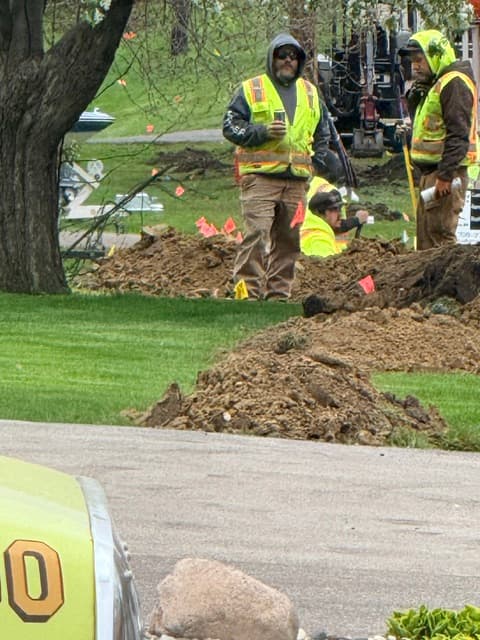
The scope that protects every other scope
Potholing is the cheapest insurance in underground construction. Physically exposing a gas main before a bore crosses it costs a few hours; hitting it costs a shutdown, a report, and a reputation. Owners who have been through one of those tend to ask about potholing before they ask about price.
We do this work for municipalities, internet service providers, and developers, most often on builds where several trades are working the same right of way and somebody has to be responsible for what is already down there.
What excavation scope covers
The dig, the verification that comes before it, and the restoration that decides whether a job closes out clean.
Open-cut trenching
Trench, bed, install, backfill, and compact on the runs where open cut is the right method rather than the default one.
Potholing and verification
Existing facilities physically exposed and measured before boring or trenching runs past them, with the findings recorded.
Vaults and handholes
Precast vaults, handholes, and pedestals set to grade, with the structural bedding and drainage that keeps them there.
Road and driveway crossings
Open crossings where boring is not warranted, restored to the pavement standard the agency requires.
Utility conflict resolution
Congested boulevards where several utilities share one corridor, opened up and worked by hand where that is what it takes.
Restoration
Compaction, topsoil, seed and sod, curb, and pavement patch to the jurisdiction's spec, so the punch list closes.
Why the excavation scope belongs with the boring contractor
Splitting the dig from the drill is how a build ends up with two contractors and one hole nobody will claim.
- Potholing done by the same company that has to bore past what it finds.
- Vault and handhole setting coordinated with the duct route rather than reverse-engineered onto it.
- Restoration written into scope, so close-out is not a separate negotiation.
- Crews and equipment that mobilize across five states.
- One contract covering excavation, boring, plowing, blowing, and aerial.
FAQ
Excavation and trenching questions
Still have a question? Call us at (651) 529-1527 and we'll walk you through it.
Yes, wherever a bore path runs close to an existing facility. Locates tell you roughly where something is; potholing shows you exactly where it is and how deep. It is a few hours of work that prevents the single most expensive event on an underground job.
We write restoration into scope: compaction, topsoil, seed or sod, curb, and pavement patch to the standard the jurisdiction sets. Leaving restoration out of a bid makes the number look better and the project close out worse.
Yes. Owner-supplied structures are common on municipal and carrier work, and we set them to grade with the bedding and drainage they need. Tell us what is being supplied and when, and we will schedule around the delivery.
Request a bid
Send us the scope.
Plans, a route, a permit set, or a description of the crossing. We will come back with questions before we come back with a number, because a bid built on assumptions helps nobody.
- info@millermn.com
- Building across MN, ND, SD, IA, WI
- Boring, plowing, blowing, excavation, waterline, and aerial
Request a bid
Tell us about the project and an estimator will follow up.